.jpg)
.jpg#Licensing)
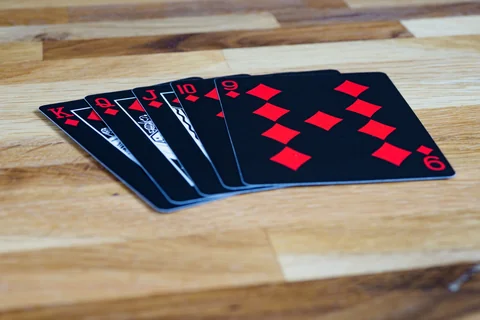
Photo: Brett Jordan · Source & licence

A joker is useful only when you understand the job it is doing. This guide uses common 13-card Indian Rummy rules and small card exercises. It does not assume that every rummy variant permits the same joker combinations or pickup rules.
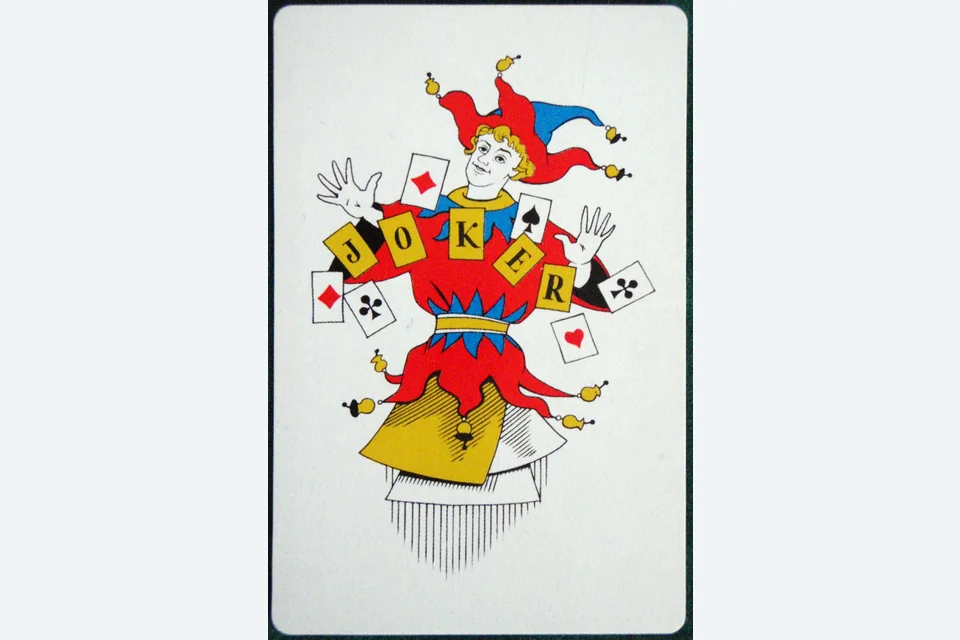
A printed joker is a dedicated joker card. A wild joker is an ordinary playing card given a substitute role by the round's selected wild rank. If threes are selected, the other threes can act as wild cards regardless of suit.
Look at the current indicator before evaluating your hand. The selected rank belongs to that round; a card you used as a joker in a previous round might now be an ordinary card. Explain the indicator to yourself before dragging cards into groups.
For this group, say: “The joker represents 5 of diamonds.”
You can then inspect the intended run, 4-5-6 of diamonds. Calling the card simply “a joker” hides the most useful part of the check: whether it fills the right rank and suit.
In a set containing king of clubs, king of diamonds, and a printed joker, the joker can represent king of hearts or king of spades under the usual substitution rule. Choose one interpretation when explaining your hand. An ordinary off-rank card cannot do this unless it is wild for the round.
Imagine these five cards are the unfinished part of your hand:
Putting the joker with 10 and jack of hearts can complete an impure run, representing queen of hearts. Putting it with the two nines can instead complete a set. You may consider both options, but you cannot claim both completed groups at once.
Inspect the rest of your hand before choosing. If you still need a second sequence, that requirement matters. Whichever option you choose here, two cards remain outside a completed group. This five-card example is a planning exercise, not a finished declaration.
Suppose 8 of diamonds, a printed joker, and 10 of diamonds form an impure sequence. Elsewhere you hold queen of spades and queen of hearts. If you obtain 9 of diamonds, those six cards can be reorganised as follows:
The run now uses its natural middle card, and the released joker can complete the queens. This is a local grouping example; you still need to check the other cards and the full 13-card declaration requirements.
Rearrangement is worth reconsidering after a useful draw. A group you made earlier is an option you can revise, not a permanent commitment.
A sequence completed by substitution is impure, so it cannot serve as the required pure sequence. A wild-rank card used at its own natural rank and suit is a separate case; see pure and impure sequences.
Also check the permitted number of substitutes in one group, unusual large sets, and whether a discarded joker may be picked up. House rules can differ, including between formats from the same provider. If the rules do not resolve an edge case, use a simpler clearly permitted grouping while learning.
Before finishing, point to each joker once and state its replacement. Then count every physical card once. This brief check catches both an impossible substitution and an accidental promise to use one card in two places.
Not when it is an allowed substitute. For example, a wild diamond can represent a missing heart. The resulting sequence is impure.
No fixed rule applies. Reassess it when a new card arrives, while keeping the required sequences and all other cards in view.
Examples and explanations are written for this guide. Check the linked rules and your chosen game’s own instructions for variations.
Photo: Brett Jordan · Source & licence
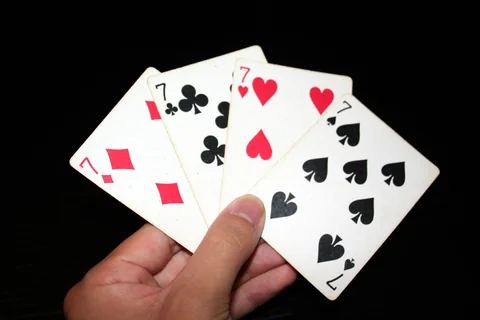
Photo: Enoch Lau · Source & licence
Have a correction? Prepare a feedback note. How we handle sources.