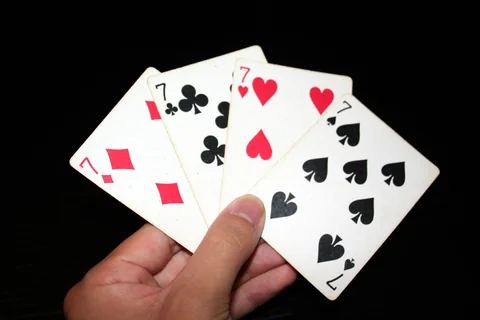
Photo: Enoch Lau · Source & licence

This beginner lesson covers a common form of 13-card Indian Rummy for free practice. Rummy is a family of games: Gin Rummy, Rummy 500, and other variants have different objectives. Check the rules of your chosen table before using this walkthrough.
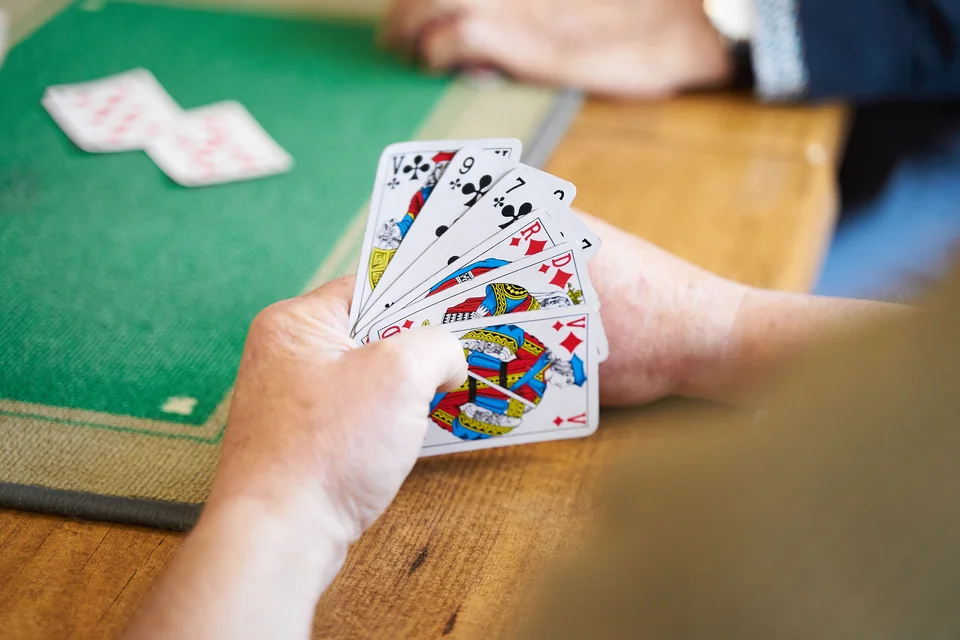
Arrange all 13 cards into permitted groups. In the version explained here, a finished hand needs at least two sequences, including at least one pure sequence. Any remaining cards must also belong to valid sequences or sets. A few attractive groups with one spare card are not enough.
A sequence follows consecutive ranks within one suit. A set matches a rank across different suits. Start by recognising these shapes before worrying about speed, points, or what another player might be holding.
Identify your hand, the face-down draw pile, the face-up discard pile, and the selected wild-card rank. The wild rank matters throughout the round; it is separate from a printed joker. Look for the table's explanation if the indicator is unfamiliar.
Sort your cards by suit and then rank. For example, put these hearts together:
They already form a natural run. Keeping it visually separate makes it easier to notice which other cards still need partners. Sorting is an organisational aid, not proof that the whole hand is valid.
Suppose you hold 8 and 9 of clubs. Drawing 10 of clubs completes a sequence. A 10 of diamonds does not complete that same run: the suit must fit as well as the number. This is a good habit for practice turns: explain exactly what the drawn card changes.
Check house rules for restrictions on picking up or returning a discarded card, especially a joker. Do not assume every app permits identical actions.
Assume no ordinary card below is acting as a substitute. These four groups account for exactly 13 cards:
| Cards | Reason |
|---|---|
| Three-card pure sequence | |
| A second pure sequence | |
| Three kings of different suits | |
| Four-card pure sequence |
Count 3 + 3 + 3 + 4. There are at least two sequences and a pure sequence, and every card belongs to one group. A set is useful here, but sets are not compulsory when all cards can instead form permitted sequences.
On a finishing turn, drawing gives you a fourteenth card. Identify the card to discard and check the remaining 13 before using the game's finish or declaration control. Button names and grouping screens vary.
Run three checks: enough sequences, at least one pure sequence, and no leftover or double-counted cards. A joker that completes a set cannot also complete another group. For a slower worked check, use our valid declaration guide.
During a free practice session, make your first goal a correctly explained hand. Scoring, turn timers, disconnections, and invalid-declaration penalties follow the particular table's rules; learning those controls is a separate task from learning card combinations.
No. This lesson is specifically about a common 13-card Indian Rummy format. Read the rules for other rummy variants separately.
No. The second sequence may also be pure. An impure sequence is an option, not a requirement.
Examples and explanations are written for this guide. Check the linked rules and your chosen game’s own instructions for variations.
Photo: Enoch Lau · Source & licence

Photo: dumitru B · Source & licence
Have a correction? Prepare a feedback note. How we handle sources.